

According to Roland Berger’s 2025 Aerospace Supply Chain Report, 64% of aerospace companies are still experiencing supply chain disruptions. The primary culprits? Increased lead times and limited raw material availability. For procurement managers juggling dozens of vendor relationships, the message is becoming clear: fewer, more capable suppliers may be the path forward.
The Hidden Cost of Supplier Handoffs
A single aerospace component often travels through multiple facilities before it’s ready for installation. Raw material goes to a machine shop. Machined parts ship to a finishing house for anodizing or passivation. Finished parts move again for assembly or testing. Each handoff introduces delay, coordination overhead, and quality risk.
Research from The Hackett Group found that onboarding a single new supplier costs approximately $1,400 in internal resources—identification, qualification, and transaction processing. Multiply that across a supply base of 50 or 100 vendors, and the administrative burden alone becomes significant. Their research also found that companies achieving top-quartile supplier consolidation see cost reductions averaging 9.18% on general equipment and supplies.
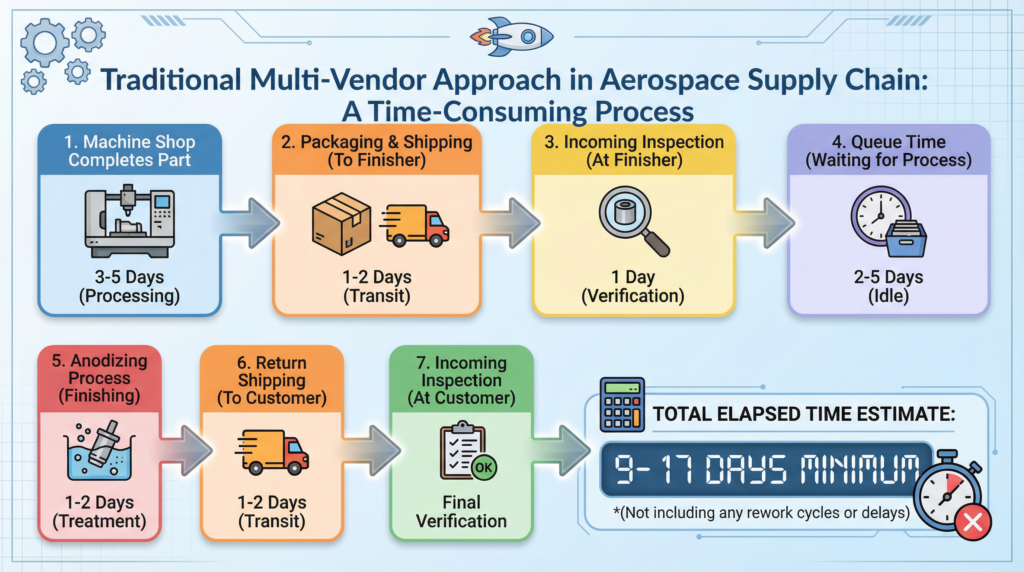
But the real cost isn’t just administrative. It’s time. When machined parts sit waiting for pickup, transit to another facility, incoming inspection, queue time, processing, and return shipping, schedules stretch. A process that could take days under one roof becomes weeks across multiple locations.
What’s Driving the Consolidation Trend
The aerospace industry is facing a perfect storm of pressures. IATA and Oliver Wyman estimate that supply chain challenges could cost airlines more than $11 billion in 2025. The commercial aircraft backlog has exceeded 17,000 units—a historic high—while the industrial base struggles to ramp capacity.
OEMs are responding by demanding more from fewer suppliers. Industry analysis from Products Finishing notes that customers are “increasingly pressuring finishers to offer a wider range of process types, all as part of an effort to provide a one-stop solution.” This isn’t about squeezing margins; it’s about reducing complexity in a system where a single aircraft requires coordination among thousands of suppliers.
For context, the Boeing 787 Dreamliner relies on more than 45 major Tier 1 suppliers. Each of those suppliers, in turn, manages their own networks of Tier 2 and Tier 3 vendors. When McKinsey analyzed executive communications across more than 50 aerospace OEMs and suppliers, they found that mentions of “shortages” increased 18-fold between 2014 and 2022. The supply chain isn’t just strained—it’s fundamentally overextended.
The Case for Integrated Manufacturing
Supplier consolidation works best when it eliminates handoffs entirely rather than simply reducing vendor count. The most significant gains come when precision machining, metal finishing, and assembly happen under one roof.
Consider the typical workflow for an aluminum aerospace component requiring hard coat anodizing:
Traditional multi-vendor approach: Machine shop completes part (3-5 days) → Packaging and shipping (1-2 days) → Incoming inspection at finisher (1 day) → Queue time (2-5 days) → Anodizing process (1-2 days) → Return shipping (1-2 days) → Incoming inspection at customer. Total elapsed time: 9-17 days minimum, not including any rework cycles.
Integrated approach: Machining completes → Part moves directly to finishing line → Anodizing process → Quality verification → Ships to customer. Total elapsed time: 3-5 days, with expedited options available when schedules demand it.
The math isn’t complicated. Eliminating transit time, duplicate inspections, and queue time at separate facilities compresses schedules dramatically. When every supplier in the chain maintains their own buffer stock and queue time, those delays compound.
Evaluating Your Current Supplier Structure
Not every component benefits equally from supplier consolidation. The strongest candidates are parts that require multiple process steps—machining plus finishing, or machining plus assembly plus finishing—where handoffs currently add days or weeks to the schedule.
Questions worth asking about your current supply base:
How many separate facilities touch a typical part before it’s ready for use? What percentage of your lead time is actual processing versus transit and queue time? When quality issues arise, how many vendors are involved in the root cause investigation? Are your machining and finishing suppliers both on your approved supplier list for the same specifications?
For organizations managing complex aerospace programs, the answers often reveal opportunities. A part that visits three facilities and takes three weeks might require only one facility and one week with the right supplier.
Take the Next Step
CMF Pro offers precision machining, NADCAP-accredited metal finishing, and assembly services under one ISO 9001 and AS9100 certified roof. We serve aerospace and defense customers including Boeing, Lockheed Martin, and Raytheon with expedited processing available—including finishing turnaround measured in hours when schedules demand it.